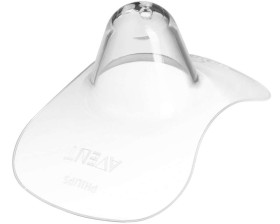
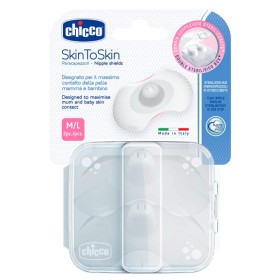
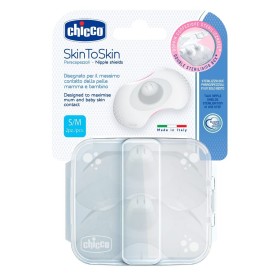
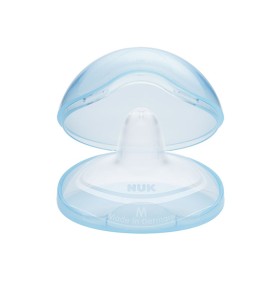
The nipple shields are designed to help you breastfeed when you face problems with your nipples or when your baby has difficulty latching on. The ultra-thin butterfly-shaped nipple shield allows contact with the breast for the baby and helps you continue to bond with your baby while breastfeeding.
Helps you breastfeed more comfortably*
They are easy on your baby and gentle on your skin*
Allows skin contact
Protection of irritated nipples
Small size (15 mm)
2 pcs.
Designed for your skin to contact with your baby
The protective breast shields with ultra-thin butterfly shape are designed for skin contact with the baby. Thanks to their special shape, not only the nipple but also the baby’s chin comes into contact with the breast, to smell and touch you. Simply place the shield over the center of the nipple so that your baby can latch on to the entire areola. Enjoy the contact with your baby while protecting your nipples at the same time.
Designed to help the baby latch on
We designed the nipple shields to help babies who have difficulty latching on, so you can breastfeed for a longer period of time. For mothers with flat or inverted nipples and babies with weak technique or oral anomalies, the shield can act as an auxiliary nipple for the baby to latch on, maintaining it during feeding breaks.
Made for sensitive or irritated nipples
The breast shields are designed to provide comfort and gentle feeding for sensitive or irritated nipples. They can help reduce friction during breastfeeding, allowing you to feed your baby comfortably.
Babies drink at their own pace
If the mother’s milk flow needs to be restricted or if the baby lacks strength, the nipple shields are also an excellent way to support. The three holes at the end of the shield can reduce milk flow if it is too high. This way, the baby can drink at their own pace, even when the mother has too much milk.
Designed for proper application
The breast shields are available in two sizes to fit your breast better. Small sizes fit diameters from 12 mm and medium sizes fit up to 21 mm. To find your size, sit comfortably and place one of the perforated rings on your nipple. Rotate the shield clockwise and guide the nipple into the channel. Then, stretch the base of the shield around the areola. If there is a 2 mm gap between the nipple and the silicone, this is the right size. Tip: size is based on the nipple, not the areola. Not sure? Ask for support from your doctor.
Easy cleaning in the hygiene carrying case
You need to clean the nipple shields before each use. This process takes less than 10 minutes. Place them in boiling water for five minutes or optionally use the hygiene case. Place both well-washed nipple shields in the case and add 25 ml/0.9 fl.oz. water. Then, place the nipple shields in a microwave oven 750-1000W for three minutes. Let them cool for five minutes. Then drain the water and they are ready to use. Use the practical hygiene carrying case when you are out of the house, as well as to store the nipple shields and keep them clean.
Combination of breastfeeding and bottle feeding
The ultra-thin, soft silicone material of the Philips Avent nipple shield is closer to infant feeding solutions, for the smooth transition between breastfeeding and bottle feeding when combining the two.
*For flat or inverted, sensitive or irritated nipples and babies who cannot latch on to the breast
*0% BPA, based on EU Regulation 10/2011




 9
9