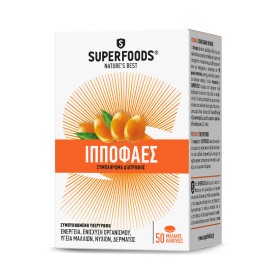
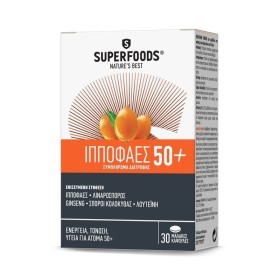
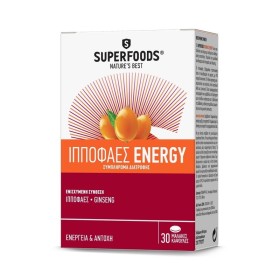
Greek Spirulina & Hippophae 400mg 120 caps.
The combination of Spirulina + Hippophae offers a (super food)² with cumulative benefits
PROPERTIES for:
- Boosting the immune system, supporting cancer protection, aiding in radio-chemo therapies .
- Energy, stimulation, increased endurance, rapid recovery, wound healing.
- Enhancing the nervous system and reducing anxiety.
- Protection against cardiovascular issues by lowering sugar and cholesterol, increasing hemoglobin - anemia.
- Relief for reproductive issues, prostate in men, menopausal symptoms in women.
- Preventive action for the visual system (cataract, macular degeneration).
- The Omega-7 fatty acids of hippophae protect the brain and cardiovascular system.
- Treatment of skin conditions, acne, eczema, burns, psoriasis, hair loss, nails.
SPIRULINA
History
SPIRULINA is a primitive multicellular microalga that appeared on Earth 3.5 billion years ago. With its ability to photosynthesize, it absorbs twice its biomass in carbon dioxide (CO2) and fixes atmospheric nitrogen (N).
Historically, Spanish conquerors of Mexico in the 16th century observed the Aztecs collecting natural spirulina with fine nets from lakes and turning it into cakes. Today, this process is systematically carried out in Lake Texcoco.
A similar process is applied in Lake Kossoron in Chad, Africa, where spirulina is a primary dietary component for local populations, especially pregnant women and in local pharmacology.
After World War II, German and French professors studied spirulina in detail. In 1967, spirulina was declared “the excellent food source of the future” by the International Union of Microbiologists.
More recently, NASA selected spirulina as the primary food source for astronauts. The various elements spirulina provides are fully water-soluble and easily digestible, offering additional energy, supplementing daily dietary deficiencies, restoring proper metabolic balance.
It increases performance in mental and physical work, exercise, and mood for competitive distinction in the spaces where every modern person operates.
According to an official publication of the Food and Agriculture Organization (FAO) of the United Nations (Circular 1034 FIMA/C1034 (En), 155N 2070-6065 of 2008), spirulina is recognized for its potential use as a supplementary cure in many diseases or problematic health conditions.
The most important is the enhancement of the immune system by Phycocyanin, which drastically reduces blood lipids, combats the feeling of “fatigue” by increasing levels of immunoglobulins A (IgA) and M (IgM)(1)
- Proteins, vitamins, minerals, and polysaccharides improve all physical performance, especially in athletes. In weightlifters, it increases lung capacity without affecting blood pressure.
- The dry biomass of spirulina contains up to 2% gamma-linoleic acid (GLA), a percentage equal to that of breast milk. This high percentage helps with arthritis, obesity, cardiovascular issues, and zinc deficiency syndrome.
- Spirulina in experiments conducted in Germany and Japan showed that it reduces cholesterol, triglycerides, and low-density lipoproteins in the blood, acting beneficially in combating atherosclerosis. (2)
- Due to its very high content of organic, readily digestible iron, spirulina directly helps in correcting anemia, low hemoglobin, and menstrual syndrome. (3)
Current studies support the positive effect of spirulina in preventing cancer (leukemias), protecting individuals undergoing radio-chemo therapies, and due to its antiviral properties, aiding those infected with the AIDS virus.
HIPPOPHAE
History
HIPPOPHAE (Hippophae Rhamnoides) is a deciduous shrub that grows throughout Western Europe and reaches Northwest China.
It is a dioecious plant with separate male and female plants that are fertilized with the help of the wind. Its name comes from the words hippos + phaos (light + shine), with adopters being the soldiers of Alexander the Great, who gave its fruits and leaves to their injured horses for rapid recovery, wound healing, more strength, and the appearance of abundant and shiny hair.
In antiquity, its use was widespread, with references from Theophrastus, Aristotle, and the father of pharmacology Dioscorides. Its dried fruits, turned into powder and mixed with spirulina powder, are literally a “plant nutritional bank” according to proven clinical trials in Russia.
Hippophae has many uses, such as in Germany and Scandinavia where they make drinks that are very rich in carotenoids and vitamin C. In Finland, it is used as an ingredient in baby foods, while in Asia it is used as a therapeutic herb for the digestive, circulatory, rheumatoid arthritis, dermatology (wound and burn healing, psoriasis due to tissue regeneration - anti-aging) and ophthalmology (age-related macular degeneration).
In 2005, the international organization “EANSEABUK” was established between the European Union, Russia, and China, aiming to promote hippophae products for the citizens of these countries.
As a “superfood” it contains:
- Many antioxidants such as: Vitamin C with an average content of 800mg per 100g, 15 times more than an orange, contributing preventively against aging, cardiovascular issues, and cancer.
- Vitamin E, 80mg per 100g, which accelerates wound healing, slows cellular aging, and enhances the reproductive system.
- Vitamin A, 60mg per 100g, which contributes to eye health (cataract, macular degeneration), treatment of skin conditions (burns, psoriasis, acne, etc.)
- Many carotenoids (alpha-carotene, zeaxanthin, lycopene, etc.)
- All minerals necessary for the function (physical and mental) of the human body.
- Water-soluble B-complex vitamins
- Sterols and flavonoids with protective action in prostate hyperplasia.
- The essential fatty acids for the proper function of the immune, reproductive, and nervous systems, while also contributing to cholesterol reduction.
- All essential amino acids (32% protein).
Packaging: 120caps/400mg




 9
9