Close
Sign in to your account
My cart Close minicart icon My cart

Products: {{countCartProducts}}
Total : {{(cartTotal * selectedCurrency.rate).toFixed(2)}}€ - {{(cartDefaultCouponDiscount * selectedCurrency.rate).toFixed(2)}}€ = {{((cartTotal - cartDefaultCouponDiscount) * selectedCurrency.rate).toFixed(2)}}€ {{(cartTotal * selectedCurrency.rate).toFixed(2)}}€

Search Close search

La Roche Posay Rosaliac

La Roche Posay Rosaliac: Care for Skin Prone to Redness

The Rosaliac range by La Roche-Posay is designed for facial skin that easily reddens, burns or stings at the slightest provocation, and that displays visible capillaries on the cheeks, nose or chin. A common denominator in all products is La Roche-Posay Thermal Water, combined with ingredients targeting the appearance of redness and the sensation of discomfort. The formulas are designed for high tolerance, with a simple composition, so as not to burden skin that already reacts.

Helpful clarification so you don’t get lost in the names: Rosaliac has gradually been integrated into the large Toleriane family. You will therefore also encounter the name Toleriane Rosaliac, as in Toleriane Rosaliac AR Concentrate or Toleriane Rosaliac AR SPF30. It is the continuation of the same logic with renewed formulas, not a different product category.

The world spells it in many ways: Rosaliac, Rosaliak, Rozaliac, rozaliak, rosaliac, rosaliaque, rosaliac, but also the brand as La Roche Posay, La Roche-Posay, Laroche Posay, larose posay, la rose posay, laroche poche or simply Roche posay. All variations lead to the same range.

Why Skin Reddenes and What Visible Capillaries Are

Beneath the epidermis lies a dense network of very fine vessels, the capillaries. Their diameter is not constant. When the body needs to expel heat or when the nervous system is activated, the vessels dilate and more blood passes close to the surface. This is vasodilation and we see it as flushing or reddening. In skin that tolerates well, the reaction is brief and the color returns quickly. In skin prone to redness, the return is slower and more incomplete.

Over the years and with many repetitions, the walls of the capillaries lose some of their elasticity. Thus some vessels remain permanently dilated and become visible as fine red lines, mainly on the wings of the nose and the cheekbones. At the same time, skin prone to redness often has a more fragile skin barrier. It loses water more easily, allows irritants to pass through more easily and reacts more strongly to products that other skin tolerates without issue.

The triggering factors are almost always the same and it is worth recognizing them in your own daily life: sudden temperature changes, heat, hot showers and sauna, icy air and cold, intense sun exposure, alcohol, coffee, spicy and very hot foods, intense exercise, stress and strong emotions. According to La Roche-Posay, environmental factors, with the sun in the lead, are responsible for a large part of the color changes on the face. Practically this means that daily sunscreen is not a detail, it is half the result.

A cosmetic does not change your vascular disposition. What it does is support the barrier, limit irritants, hydrate and visually neutralize red with green pigments. The improvement concerns the appearance of redness and the sensation of comfort, it is not a cure.

What to Watch for When Choosing a Product for Redness

  • Simple composition and high tolerance. The fewer the ingredients, the fewer the potential sources of irritation. Prefer formulas without fragrance or with minimal fragrance and without drying alcohol.
  • Sunscreen in the routine. UV radiation burdens the appearance of redness all year round. A hydrating with SPF or a sunscreen for sensitive skin makes a big difference in the consistency of the result. No SPF is complete protection and repetition during the day remains necessary.
  • Green pigments for immediate visual correction. Green is opposite red on the color wheel and visually neutralizes it. It is an immediate cosmetic result, independent of long-term care.
  • Gentle cleansing. Soap with high pH, scrubs with grains and very hot water are among the most frequent reasons why redness does not subside, no matter how good the cream is.
  • Consistency rather than tensions. Changing products every fortnight does not allow the skin to calm down. Give a routine at least four to six weeks.

What the Rosaliac Range Contains

  • La Roche-Posay Thermal Water. The water from the La Roche-Posay spring, rich in selenium. It is used throughout the brand for its soothing sensation and reduction of the feeling of irritation.
  • Ambophenol. A plant-based extract with antioxidant properties, which according to the manufacturer specifically targets the appearance of redness. It is the historic signature ingredient of the range.
  • Neurosensine. An ingredient that, according to the manufacturer, reduces the sensation of discomfort and the reactivity of sensitive skin.
  • Sphingobioma. A newer active in Toleriane Rosaliac formulas, which according to the manufacturer acts on the microbiome function and helps reduce the appearance of redness.
  • Glycerin and hydrating factors. Keep water in the upper layers and support the sensation of comfort, which in sensitive skin counts as much as the redness itself.
  • Green pigments. In the tinted products of the range, such as the CC Cream, they visually neutralize red and even out the tone from the first application.

The Products in the Range and How They Differ

  • Rosaliac AR Intense 40ml. Concentrated care with a light, fluid texture for skin with intense and established tendency to redness. Apply before moisturizer, on clean skin, morning and evening or only evening depending on tolerance.
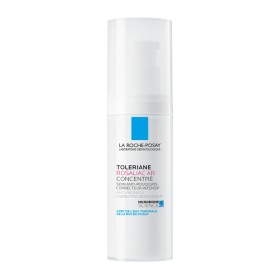
  • Toleriane Rosaliac AR Concentrate 40ml. The newer generation of the above concentrate, in the logic of the Toleriane family. Same place in the routine, renewed formula. If you were looking for the AR Intense and can’t find it, this is the corresponding option.
  • Rosaliac CC Cream SPF30 50ml. Tinted moisturizer with a light coverage effect and SPF. Combines three things in one step: hydration, visual correction of red and sunscreen in the daily life of the city. Chosen by those who want an immediate result without heavy makeup.
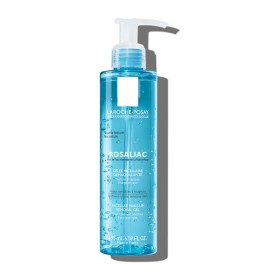
  • Rosaliac Micellar Cleansing Gel 195ml. Cleansing and makeup-removing gel for very sensitive and reactive skin. Rinses off, leaves a feeling of freshness without pulling and is the first step that makes the difference, because aggressive cleansing is itself a triggering factor.

The logic of the routine is simple: cleansing with the micellar gel, followed by the AR concentrate on clean skin, and in the morning the CC Cream or a moisturizer with SPF. In the evening, a moisturizer for sensitive skin is sufficient.

When People Use It

In real situations, the range usually appears like this: someone who reddens on their cheeks with the first cold of winter or as soon as they enter a warm space from the cold. Someone who notices a permanent pink background on their nose and cheekbones after their thirties and wants to cover it without layers of makeup. People who sting with almost every new product and are looking for something lean and tolerable. People who work in a kitchen, outdoors or who do intensive exercise and live daily with flushing. And those who have already heard the word rosacea from a dermatologist and are looking for cosmetic support alongside whatever they have been prescribed.

A doctor is needed when the redness is persistent and does not subside, when pustules or pimples appear, when there is swelling or thickening of the skin on the nose, when the eyes are involved with burning and irritation, or when the picture worsens quickly. Rosacea and seborrheic dermatitis are medical conditions and need diagnosis and treatment by a dermatologist. The cosmetics in the range improve the appearance of redness and the sensation of comfort, they are not medicines and do not substitute for medical care.

Frequently Asked Questions

Does Rosaliac cure rosacea?

No. Rosacea is a dermatological condition and is treated by a doctor. The products in the range are cosmetics and aim to improve the appearance of redness and the sensation of comfort of the skin. Many use them alongside what their dermatologist has prescribed.

What is the difference between AR Intense and CC Cream?

AR Intense is concentrated care that works over time and goes under the moisturizer. The CC Cream is a tinted moisturizer with SPF that gives an immediate visual result by covering the red. They do not compete, they combine.

Has Rosaliac become Toleriane Rosaliac?

Yes, to a large extent. La Roche-Posay is gradually integrating Rosaliac codes into the Toleriane family, with names like Toleriane Rosaliac AR Concentrate and Toleriane Rosaliac AR SPF30. The direction remains the same, skin prone to redness.

How long before I see a result?

The tinted effect of the CC Cream is immediate, from the first application. For care with the AR concentrate, a reasonable evaluation horizon is four to six weeks of daily use, always in combination with avoiding triggering factors.

Is it for acne or pimples?

No, that is not the direction of the range. For skin prone to acne, La Roche-Posay has the Effaclar range. If redness and pustules or pimples coexist, talk to a dermatologist first, because the combination requires proper distinction.

Is it for couperosis and visible vessels?

The already formed, permanently dilated vessels do not disappear with a cosmetic. The range helps with the appearance of general redness and covers it visually with the tinted products. For the vascular picture itself, solutions such as laser are discussed only with a dermatologist.

Can I use it in pregnancy or breastfeeding?

These are external use cosmetics, however every pregnancy is unique and skin sensitivity changes. Ask your pharmacist or doctor before adding anything new to your routine.

Does it contain fragrance, alcohol or parabens?

The formulas for skin prone to redness are designed with a simple composition and high tolerance, however the exact list differs by product and by formula revision. If you have a known sensitivity, read the ingredient list on the packaging or ask the pharmacist.

Does it combine with other La Roche-Posay ranges?

Yes. Common combinations are with Toleriane for cleansing and hydration, with Anthelios for sunscreen on sensitive skin and with Cicaplast for periods of intense dryness or tightness. Avoid adding strong actives at the same time, such as retinol or acids, without guidance.

From what age can it be used?

The tendency to redness often appears from the mid-twenties to thirties and intensifies with age, so the range is mainly aimed at adults. For children and teenagers with persistent redness, the right path is the pediatrician or dermatologist.

How is it stored?

At room temperature, away from direct sun and humidity, with the cap well closed. After opening, follow the expiration date indicated on the packaging.

Cosmetic products. The reported actions refer to cosmetic action, in accordance with Regulation (EC) 1223/2009. The text is for informational purposes and does not replace the advice of a doctor or pharmacist.

2 Products


//