Close
Sign in to your account
My cart Close minicart icon My cart

Products: {{countCartProducts}}
Total : {{(cartTotal * selectedCurrency.rate).toFixed(2)}}€ - {{(cartDefaultCouponDiscount * selectedCurrency.rate).toFixed(2)}}€ = {{((cartTotal - cartDefaultCouponDiscount) * selectedCurrency.rate).toFixed(2)}}€ {{(cartTotal * selectedCurrency.rate).toFixed(2)}}€
Search Close search

La Roche Posay Substiane

La Roche Posay Substiane: Care for Mature Skin That Has Lost Volume

Substiane is the La Roche-Posay line that doesn’t focus primarily on wrinkles, but on something harder to describe: the feeling that the face looks emptier. The issue here isn’t a furrow on the forehead, it’s the blurring outline, the skin that feels thinner to the touch, and the surface that doesn’t spring back as quickly when lightly pressed. It is aimed at mature skin, often also at sensitive skin, and the common thread of its products is Pro-Xylane along with hydrating ingredients in rich textures.

The world writes it in many ways: substiane, sambstian, sumbstian, samsstian, substiane plus, substiane +, substiane yeux, sustian, sustaine, La Roche Posay substiane, larose posay substiane, la rose posay substiane, Roche posay substiane. They all lead to the same line, so it doesn’t matter if you’ve grasped it differently.

What Changes in the Skin After Menopause?

The period around menopause brings a change to the skin that most women describe as happening suddenly. The drop in estrogen directly affects three things at once: how much sebum the skin produces, how much water it retains, and how dense the underlying support layer is. The result isn’t just more wrinkles, it’s a different surface quality. The skin becomes drier, thinner to the touch, more easily irritated, and often duller, even in women who never had dry skin in their lives.

At the same time, the architecture of the face changes. The fat compartments beneath the skin shrink and shift downward, while the underlying bone skeleton also subtly changes over the years. That’s why the mature face looks less full in the cheekbones and heavier lower down, with more pronounced lines from the nose to the mouth. No cream changes this geometry, and no cosmetic should promise to. What a good formula can offer is well-hydrated, denser-to-the-touch skin with a more even light reflection, which visually softens the appearance.

There’s also a practical factor that is overlooked: mature skin reacts differently to cleansers. A foaming gel that was perfect in your thirties might now leave a tightening sensation, and that alone worsens the appearance of lines within hours.

Why Mature Skin Wants a Different Texture Than Skin in Your Mid-Thirties

In your mid-thirties, the main concern is usually surface prevention and correction. The skin still produces enough lipids, the barrier works, so a light hydrator with an active ingredient is a logical choice. Mature skin has a different problem. It doesn’t lack correction as much as support: it needs lipids to retain water, it needs greater tolerance because it has become more reactive, and it needs a texture that stays on it without making it shiny.

This explains why formulas for mature skin are thicker and more nourishing. It’s not market differentiation, it’s a response to the fact that the skin has less of its own lipid reserves. At the same time, the rich texture has an immediate visual benefit: it temporarily fills the micro-reliefs of the surface, so light doesn’t catch them and fine lines appear less pronounced from the very first application.

There’s also a difference in approach. In skin in your mid-thirties, the routine is often built around a strong active ingredient. In mature skin, stability counts more than intensity. A simple, nourishing, well-tolerated routine that is followed every day gives a more consistent appearance than an aggressive routine that is interrupted every time the skin gets irritated. And because mature skin recovers more slowly from irritation, the cost of a mistake is higher.

What to Watch for When Choosing Care for Mature Skin

  • Texture richness. If you still feel tightness after application, the texture is too light for you. If the product remains greasy after twenty minutes, it’s too heavy.
  • Tolerance before intensity. Check first if the skin accepts the product without redness or stinging, and then consider whether you want to add something stronger.
  • Covering the entire area. The neck and décolletage often age more visibly than the face because we ignore them for decades.
  • Special care for the eyes. In mature skin, the eye contour is the thinnest point and doesn’t hold the same amount of product as the rest of the face.
  • Consistency. Daily use for weeks, not intensive periods with gaps in between.

What the Substiane Range Contains

  • Pro-Xylane. The signature ingredient around which La Roche-Posay built the line for mature skin. Used cosmetically to improve the appearance of density and firmness to the touch.
  • Glycerin. A hydrating agent that retains water and reduces the sensation of tightness, crucial in skin that has become drier.
  • Hyaluronic Acid. Gives an immediate feeling of a fuller surface and helps fine lines appear less visible.
  • La Roche-Posay Thermal Water. The spring water that characterizes all the brand’s ranges, with a soothing sensation on skin that is easily irritated.
  • Lipid Base. The rich textures of the range also act as a layer that limits water loss from the surface during the day.

The Products in the Range and How They Differ

Substiane is small and deliberately focused. It isn’t a range with ten codes where you have to choose between variations, it’s two products with a clear role each.

  • Substiane [+] 40ml. The face cream of the range, in a rich texture for daily application on the face and neck. Chosen by those who feel their skin is thin and dry and want a fuller appearance and a more rested look throughout the day.
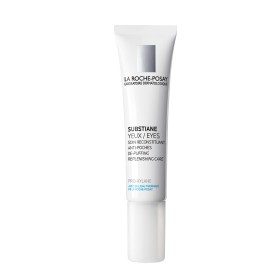
  • Substiane Yeux 15ml. The eye contour care, in a small package because the amount per application is minimal. Targets the area that shows tired first, with fine lines and a look that seems heavier.

The most common way to use it is to combine the two: the Yeux first with light patting on the bony contour, then the face cream on the face and neck with upward movements. In the morning, sunscreen is also needed on top, because mature skin shows spots more easily.

When People Use It

The most common time is when the until-then cream ceases to suffice. Some have used the same product for years and suddenly feel it absorbs in two minutes and then the skin asks again. Others notice it in makeup: the makeup settles into the lines or looks dusty, something that didn’t happen before.

A second typical time is winter, when heating and cold air bring a tightening sensation to skin that has already become drier. And a third is the transition after menopause, when many women rebuild their routine from scratch because nothing they knew behaves as it used to.

Two things are worth stating clearly. First, these products are cosmetics and improve the appearance, they don’t replace medical or aesthetic procedures and they don’t intervene in the structure of the face. Second, if dryness is intense and persistent, if there is itching, if new spots or lesions appear, or if you are taking medication that dries the skin, the right move is to talk to a doctor, dermatologist or pharmacist, not to try yet another cream.

Frequently Asked Questions

What is the difference between Substiane and Redermic?

Different concern. Redermic is built around actives like retinol and vitamin C and primarily targets the appearance of wrinkles and radiance. Substiane is aimed at mature skin and emphasizes the feeling of density, nourishment and tolerance. If your skin is dry and thin, Substiane has a more suitable texture. If specific lines are your main concern, Redermic is more targeted.

Is it only for women in menopause?

No. Menopause is the most common trigger, but the criterion is the skin’s condition. Dry, thin skin with loss of density can appear earlier, for example after prolonged sun exposure or in very thin individuals. Men with mature dry skin also use it.

Does it go on the neck and décolletage?

Yes, and it’s one of the few cases where it really is worth it. The neck has thinner skin and fewer sebaceous glands than the face, so it dries earlier. The décolletage also receives a lot of sun without protection.

Is it too rich for combination or oily skin?

Likely yes for the day. A mature but still oily skin usually finds it heavy in the morning. A solution many apply is using it only in the evening and a lighter hydrator during the day.

Morning or evening?

Both are acceptable. The evening has the advantage that it doesn’t need to coexist with sunscreen and makeup. The morning has the advantage that the skin withstands the day better without a tightening sensation.

Can I combine it with retinol?

Yes, but not necessarily the same evening and not from the first day. A common tactic is retinol a few times a week and the nourishing cream the other evenings, so the skin has time to recover.

Does it help with hot flashes or other menopause symptoms?

No. These are cosmetic products for local application and have nothing to do with systemic menopause symptoms. For hot flashes, sleep disturbances or hormonal issues, the right conversational partner is your gynecologist. They don’t replace any treatment.

Does it contain fragrance or parabens?

La Roche-Posay states the composition of each product on the packaging. If you have a known intolerance to fragrance or to specific preservatives, read the ingredient list of the code you will receive or ask the pharmacist to review it with you.

How long before I see something?

The sensation of nourishment and the immediate visual improvement of micro-lines appear very quickly, because they are due to hydration. The difference in the feeling of density takes daily use for weeks. The times mentioned on the packaging are manufacturer claims.

How is it stored?

At room temperature, away from direct sunlight and from the humidity of the bathroom next to the shower. Close the jar tightly and avoid putting wet fingers inside.

Does the Substiane Yeux go on the eyelids?

Applied to the bony contour around the eye, not to the mobile eyelid and never to the eyelid margin. If you wear contact lenses or have sensitive eyes, start with a very small amount.

Cosmetic products. The reported actions refer to cosmetic action, in accordance with Regulation (EC) 1223/2009. The text is for informational purposes and does not replace the advice of a doctor or pharmacist.

2 Products


//